Torque Calculator
Calculate torque from applied force and moment arm (T = F × r) with SI and Imperial unit support.
Calculator
Example Result
Your result will appear here
The calculated result will appear here after you press Calculate.
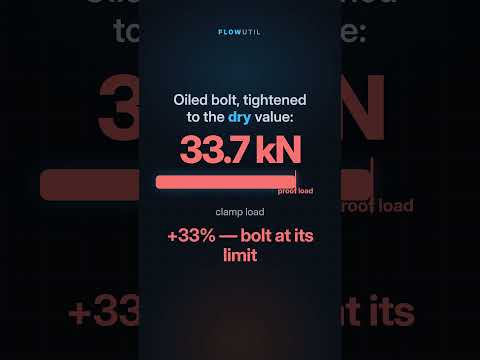
Watch: M10 Bolt: 50 Nm or 37 Nm? Dry vs Oiled Threads
YouTube Short · 0:29
The same M10 class 8.8 bolt has two correct torque values: about 50 N·m with dry threads (K ≈ 0.20) and about 37 N·m with oiled threads (K ≈ 0.15). T = K × F × d: oil cuts thread friction, so tightening an oiled bolt to the dry value raises the clamp load from about 25 kN to about 34 kN, right at proof load.
Plays in YouTube’s privacy-enhanced player; nothing loads from YouTube until you press play. Watch on YouTube
About the Torque Calculator
Torque is the rotational equivalent of linear force — it measures how much a force causes an object to rotate about a pivot or axis. The torque formula T = F × r states that torque equals the applied force multiplied by the perpendicular distance from the pivot point to where the force is applied, a distance known as the moment arm or lever arm. Engineers use torque calculations every day: selecting the right motor for a drive system, specifying torque wrench settings for bolted joints, designing shafts and couplings, and calculating the mechanical advantage of levers and gear trains. This calculator supports both SI units — Newtons and metres producing Newton-metres — and Imperial units — pound-force and feet producing pound-feet. It automatically converts your result across all common torque units so you can compare values or carry the figure into the next stage of your design.
How to Use the Torque Calculator
- 1
Select your unit system — SI (metric) or Imperial.
- 2
Enter the force applied in Newtons (SI) or pound-force (Imperial).
- 3
Enter the moment arm — the perpendicular distance from the pivot to where the force acts.
- 4
Press Calculate. The result is shown in all common torque units automatically.
Torque Calculator Examples
Frequently Asked Questions
What is torque?
What is a moment arm?
What are the SI units for torque?
How do I convert N·m to lb·ft?
What is the difference between torque and moment?
How does torque relate to power?
What is a typical motor torque value?
How do I calculate torque for a bolted joint?
By O.E. — Partner, chairman of the board and CEO of a metal products manufacturer for 21 years; the company exports to 45 countries.
Drafted with AI assistance; calculations checked against primary sources and tested with the site's own code. About FlowUtil
Last reviewed
How Torque Is Calculated
FlowUtil applies the fundamental torque relation T = F × r, where T is the torque, F is the applied force, and r is the perpendicular moment arm from the rotation axis to the line of action of the force. In SI units a force in newtons multiplied by a moment arm in metres gives torque in newton-metres (N·m); in Imperial units a force in pound-force multiplied by a moment arm in feet gives pound-feet (lb·ft). The result is converted across N·m, kN·m, lb·ft, and lb·in so the same figure can be carried into the next design step in whichever unit is needed.
The formula assumes the force is applied perpendicular to the moment arm. If the force acts at an angle θ to the arm, the effective torque is F × r × sin(θ); this calculator covers the common case where the force is applied at 90°, so sin(θ) = 1 and the full product contributes. The conversion factor 1 N·m = 0.737562 lb·ft is exact to the precision shown and derives from the defined relationships between newtons, pounds-force, metres, and feet.
| Symbol | Meaning |
|---|---|
| T | Torque (N·m or lb·ft) |
| F | Applied force, perpendicular to the arm (N or lbf) |
| r | Moment arm — perpendicular distance from axis to force line (m or ft) |
Torque in SI and Imperial Units
1SI: 500 N applied at a 0.25 m moment arm.
T = F × r = 500 × 0.25 = 125 N·m
T = 125 N·m · ≈ 92.20 lb·ft
A 500 N push on a 0.25 m wrench produces 125 N·m of torque — a typical small servo or hand-tightened industrial joint. The same force on a 0.5 m arm would double the torque to 250 N·m, which is why longer wrenches loosen stubborn bolts more easily.
2SI: 2000 N applied at a 0.05 m motor shaft radius.
T = 2000 × 0.05 = 100 N·m
T = 100 N·m · ≈ 73.76 lb·ft
A belt delivering 2000 N of tangential pull on a 50 mm pitch radius loads the shaft with 100 N·m of torque. Combined with the shaft speed, this figure feeds directly into the Power Calculator (P = T × ω) to size the motor.
3Imperial: 75 lbf applied at a 2 ft moment arm.
T = F × r = 75 × 2 = 150 lb·ft
T = 150 lb·ft · ≈ 203.37 N·m
A 75 lbf pull on a 2-foot breaker bar gives 150 lb·ft — a common wheel-lug or large-bolt tightening range. Note the unit is pound-feet (lb·ft) for torque, distinct from foot-pounds (ft·lbf) used for energy; the numerical value is the same but the physical quantity differs.
Understanding the Result
The result is a rotational moment expressed in N·m (SI) or lb·ft (Imperial). Physically it represents the tendency of the applied force to rotate the object about the axis; a larger torque means more rotational effect for the same geometry. The four unit stats let you read the same torque in whichever convention a datasheet, standard, or colleague uses.
Torque alone does not determine whether a shaft or bolt will survive — it must be combined with geometry to find stress (torsional shear τ = T·r/J) or with angular speed to find power (P = T × ω). Treat the torque value as an input to those downstream checks rather than as a pass/fail number on its own.
The calculation assumes a perpendicular force and a rigid, frictionless moment arm. Real systems include bearing friction, shaft flexibility, and force components that are not perfectly tangential, all of which reduce the effective torque delivered to the load.
What T = F × r Assumes
- Perpendicular forceThe formula uses the full F × r product, valid when the force acts at 90° to the arm. At an angle, multiply by sin(θ).
- Rigid armThe moment arm is treated as rigid; deflection or elasticity in the lever reduces delivered torque.
- No friction lossesBearing and pivot friction are not deducted; the result is the torque applied at the point of action, not necessarily the torque reaching the load.
- Unit consistencySI inputs (N, m) and Imperial inputs (lbf, ft) are handled separately by the unit toggle — do not mix units within one calculation.
Where This Comes Up
Typical engineering situations where this calculation is needed.
- Motor and drive sizingFind the torque a belt, chain, or gear delivers to a shaft so the motor and coupling can be selected.
- Wrench and lever designDetermine the handle length or force needed to reach a specified tightening or loosening torque.
- Shaft stress inputSupply the torque value to torsional-stress and shaft-diameter calculations.
- Power calculationCombine the torque with rotational speed to compute shaft power in watts or horsepower.
Torque Mistakes on the Bench
- Confusing torque and momentTorque is a twisting moment about a shaft axis; a bending moment acts to bend a beam. Both use F × r but describe different loading.
- Mixing SI and Imperial unitsEntering newtons with feet, or pound-force with metres, gives a numerically wrong result. Use the unit toggle to keep a system consistent.
- Using diameter instead of radiusr is the distance from the axis to the force line — for a shaft that is the radius, not the diameter. Halving a diameter gives the radius.
- Confusing lb·ft and ft·lbfPound-feet (lb·ft) is torque; foot-pounds (ft·lbf) is energy. The numbers coincide but the quantities do not.
Explore Knowledge
Deepen your understanding with in-depth engineering guides, formulas, and worked examples.
Browse Engineering Guides